
Key Takeaways
- Most modern decorative chandeliers can be integrated into a smart home lighting system provided they are compatible with dimmable LED bulbs or smart bulb formats.
- Smart dimmer switches are often the simplest route to smart control for a chandelier - no bulb replacement is required if the existing bulbs are already LED and dimmable.
- Colour temperature adjustability, available on many smart lighting systems, is one of the most practically useful features for a chandelier used in a multi-purpose living space.
- Not all decorative chandeliers are compatible with every smart dimmer - checking compatibility between the dimmer, the bulbs, and the fixture is an important step before purchasing.
- The visual character of the chandelier remains the primary design consideration - smart functionality should enhance the fixture's role in the room, not define it.
- Metro Elegance stocks a range of chandeliers with LED-compatible and adjustable lighting features suited to British homes exploring smarter lighting control.
There is something slightly incongruous about a chandelier - an object with roots in medieval candlelit halls - being controlled by a voice command or a smartphone app. And yet the combination works rather well in practice, because a chandelier's greatest asset has always been its ability to set the mood of a room, and smart lighting control gives that ability a precision and convenience that manual dimmer switches can only approximate.
A significant proportion of UK homeowners are now integrating some form of smart lighting into their homes. For those who have, or are considering, a chandelier as part of their lighting scheme, understanding how smart control systems interact with decorative fixtures is worth the time it takes to work through the details.
This guide covers the practical side of connecting a chandelier to a smart home system - from the different control approaches available to the compatibility questions worth asking before purchasing - alongside the broader consideration of how to use smart lighting to genuinely enhance a room rather than simply add a layer of technology to it.
Why Smart Control Makes Particular Sense for Chandeliers
Chandeliers are, more than most light fittings, used to set a room's atmosphere. A chandelier above a dining table needs to produce different light for a family weekday dinner, a hosted dinner party, and a quiet evening when the room is empty but the lighting is still on. A chandelier in a living room needs to shift between working light during the day and a warmer, lower-intensity atmosphere in the evening.

Manual dimmer switches have served this purpose for decades. Smart lighting control extends the concept in several useful directions: remote control from anywhere in the home or externally, scheduling and automation, scene-setting where multiple lights in a room change simultaneously, and - in systems that support it - colour temperature adjustment that manual dimmers cannot provide.
For a chandelier specifically, the scene-setting capability is particularly useful. Being able to shift the chandelier from full brightness for practical tasks to 30% brightness at a warmer colour temperature for an evening gathering - with a single tap or a voice command - is a genuinely meaningful quality-of-life improvement for a room where light quality matters.
The Three Main Approaches to Smart Chandelier Control
There are three practical routes to integrating a chandelier into a smart home lighting system, each with different implications for cost, compatibility, and ease of installation.
1. Smart Dimmer Switch
A smart dimmer switch replaces the existing wall switch and allows the chandelier to be controlled via an app, a voice assistant (such as Amazon Alexa, Google Assistant, or Apple HomeKit compatible controllers), or scheduled automations - without changing any of the bulbs in the fixture.
This is often the simplest and most cost-effective route, particularly for chandeliers with multiple bulb positions where replacing every bulb with a smart bulb would be expensive. The main compatibility consideration is ensuring that the smart dimmer is compatible with the type of bulbs in the chandelier (LED bulbs have specific dimming requirements that not all dimmers meet) and that the chandelier itself is rated for dimming.
UK-compatible smart dimmers from brands such as Lutron, Philips Hue (for their own ecosystem), and various Z-Wave and Zigbee compatible devices are widely available. The specific compatibility requirements vary by device and bulb type, so checking the manufacturer's guidance before purchasing is advisable.
2. Smart Bulbs
Smart bulbs replace the standard bulbs in the chandelier with individually controllable LED units that connect via Wi-Fi, Zigbee, or Bluetooth to a smart home hub or app. This approach does not require any changes to the wall switch, though a standard (non-smart) dimmer switch may need to be replaced with a standard on/off switch to avoid interference with the smart bulb's own dimming capability.
The advantage of smart bulbs is the additional functionality they can provide - particularly colour temperature adjustment and, in some ranges, full colour change capability. The practical limitation is cost: a chandelier with six, eight, or twelve bulb positions requires that many smart bulbs, which can represent a significant outlay depending on the brand and bulb type chosen.
Compatibility with the bulb fitting type is also important. Chandeliers use a range of bulb fittings - E14, E27, G9, and GU10 are common in UK chandeliers - and smart bulb availability varies by fitting type. Checking which fitting your chandelier uses before purchasing smart bulbs avoids the frustration of an incompatible purchase.
3. Chandeliers with Integrated Smart or Adjustable LED Technology
An increasing number of contemporary chandeliers include integrated LED modules rather than replaceable bulb positions. Some of these integrated systems include built-in colour temperature adjustment or dimming capability that can be controlled by a dedicated remote or by a standard smart dimmer switch.
This approach provides smart-adjacent functionality without requiring a separate smart home ecosystem. It is simpler to implement but typically less flexible in terms of integration with broader smart home platforms.
Our luxury crystal chandelier with 3-colour adjustable light for living rooms and kitchens is an example of this integrated approach. The 3-colour adjustable lighting - warm, neutral, and cool white - is selectable directly from the fixture without requiring external smart home infrastructure, which makes it a practical option for homeowners who want colour temperature flexibility without the complexity of a full smart lighting setup.
Compatibility: What to Check Before You Buy
Compatibility is the area where most problems arise when integrating chandeliers with smart lighting systems, and it is worth addressing in practical terms.
Bulb fitting type: Confirm which bulb fitting your chandelier uses (E14, E27, G9, GU10, or an integrated LED module) and verify that smart bulbs in that fitting are available in the ecosystem you plan to use.
Dimmer compatibility: If using a smart dimmer switch, check that the dimmer is compatible with both the smart home platform you are using and the specific bulb type in the chandelier. LED dimming compatibility lists are typically published by both dimmer and bulb manufacturers. Using an incompatible dimmer with LED bulbs can cause flickering, buzzing, or reduced bulb lifespan.
Minimum load requirements: Some smart dimmers have a minimum wattage requirement. Modern LED bulbs often draw very low wattage, and a chandelier with multiple low-wattage LED bulbs may fall below the dimmer's minimum load, causing performance issues. A load correction device (sometimes called an LED driver corrector or trailing edge converter) can address this in some cases.
Hub requirements: Some smart bulb ecosystems require a dedicated hub to function; others connect directly via Wi-Fi. If you already have a smart home hub (such as a Samsung SmartThings hub, an Amazon Echo with Zigbee built in, or a dedicated Philips Hue Bridge), check that the products you are considering are compatible with your existing infrastructure.
For a broader look at how chandelier selection and technology considerations intersect in the context of British homes, our piece on how to choose a chandelier that suits your home's style and practical requirements covers the foundational decisions well alongside the aesthetic ones.
Practical Smart Lighting Scenarios for Chandeliers
Understanding the theory of smart chandelier control is one thing; thinking through how it actually improves daily life in a specific room is more useful.
The Dining Room
This is the room where smart chandelier control delivers the most obvious everyday benefit. A dining room chandelier needs to perform across a wide range of scenarios - bright and practical for homework or daytime tasks, warm and mid-level for family meals, low and atmospheric for hosted dinners.
With a smart dimmer or smart bulbs, these scenes can be saved and recalled with a single command. Many homeowners set up named scenes - "dinner," "entertaining," "cleaning" - that adjust the chandelier to pre-set brightness and colour temperature combinations. The consistency this provides, compared to manually adjusting a dimmer each time, is a quiet but meaningful quality-of-life improvement.
The Living Room
In a living room, a chandelier on smart control works best as part of a layered lighting scheme alongside table lamps and floor lamps. A smart system that allows all light sources in the room to be adjusted simultaneously - rather than requiring each lamp to be switched independently - produces a more cohesive result.
Scheduling is useful here too. A smart chandelier can be set to dim automatically at a certain time in the evening, reinforcing the room's transition from daytime activity to evening relaxation without any manual intervention.
Our round crystal chandelier with black ceiling light fixture and adjustable height suits a living room smart lighting setup well. The 3-colour mode adjustment provides the range of colour temperatures needed to serve different times of day, and the adjustable height means the fixture can be positioned precisely for both visual impact and light distribution in the specific room.
The Hallway
A hallway chandelier on a smart system benefits particularly from motion-triggered or scheduled automation. A hallway that lights up automatically when someone enters - and dims or switches off after a set period of inactivity - serves the practical function of the space without requiring any manual switching. For homes where the hallway chandelier is also a decorative feature visible from the street or from the living space, scheduling the chandelier to come on at dusk and off at a set time adds a welcoming quality to the exterior of the home.
Energy Efficiency and Smart Control
Smart lighting systems often include energy monitoring features that allow homeowners to track usage over time. For a chandelier with multiple bulb positions, understanding the fixture's actual energy consumption - and the effect of dimming on that consumption - can be a useful tool for managing energy costs.
LED bulbs consume significantly less energy than halogen or incandescent equivalents. A chandelier with eight 5-watt LED bulbs uses 40 watts at full brightness; the same fixture with 40-watt halogen bulbs would use 320 watts. Dimming LED bulbs further reduces consumption, though the relationship is not always linear and varies by dimmer type and bulb specification.
For homeowners thinking about chandelier lighting from an energy efficiency perspective, our overview of making energy-conscious chandelier choices for British homes covers the LED and efficiency considerations in practical terms that are relevant whether or not smart control is part of the plan.
Choosing Chandeliers That Work Well With Smart Systems
Not every chandelier is equally well suited to smart lighting integration. Fixtures with standard replaceable bulb positions in common fitting types (particularly E14 and E27) offer the widest compatibility with smart bulb ecosystems. Fixtures with integrated LED modules may have built-in colour temperature or dimming features but may be less straightforward to integrate with third-party smart platforms.
At Metro Elegance, we find that customers approaching chandelier selection with smart home integration in mind benefit from considering the technical specifications alongside the aesthetic ones - both matter to how the fixture performs in daily life. Our full chandelier lighting range includes options with integrated adjustable LED technology as well as fixtures with standard bulb positions, and the product pages include the technical information needed to assess compatibility with your existing setup.
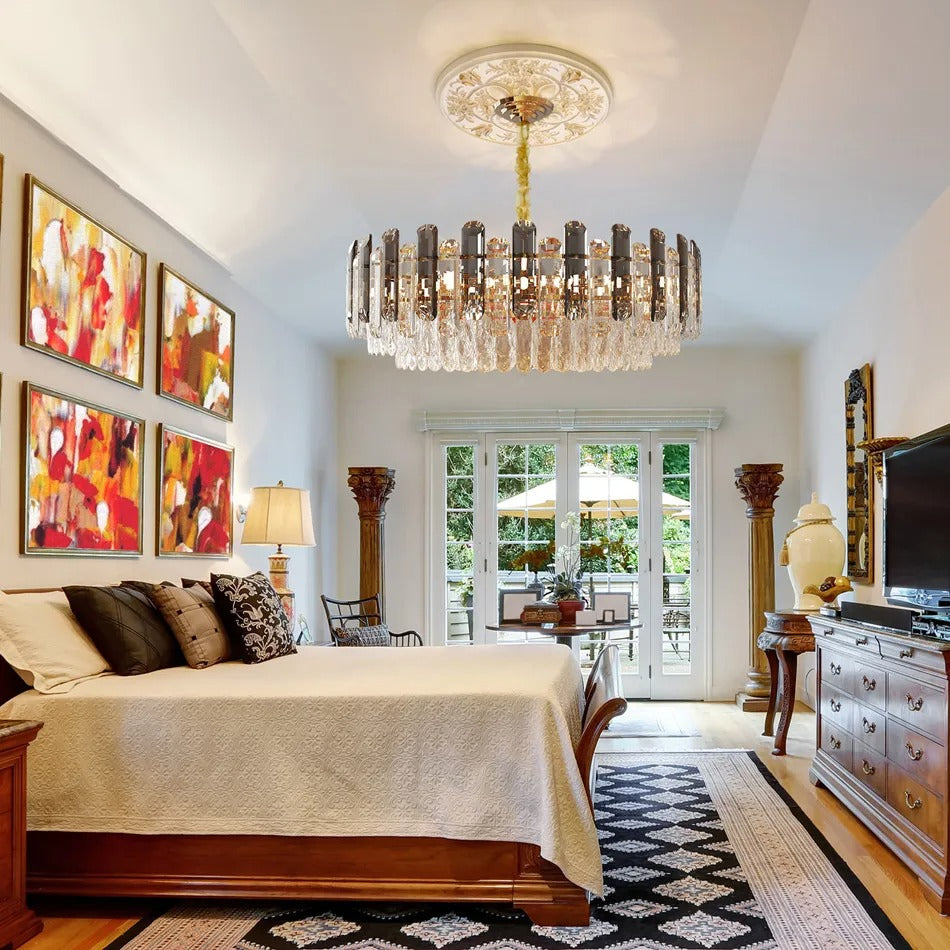
Our 3-layer modern LED ceiling chandelier with acrylic water drop pendant design and 3-colour adjustable lighting is particularly well suited to homeowners who want colour temperature flexibility and contemporary LED efficiency without requiring a full smart home ecosystem to access those features.
For those who want to understand how different chandelier styles - including those with smart-compatible features - have evolved in British homes over time, our piece on the history of chandeliers in British interiors from classic to contemporary provides useful context for how the technology has changed alongside the design.
And for those building out a crystal chandelier scheme where smart control is a priority, the product pages include bulb fitting information to help you assess smart bulb compatibility before making a decision.
Have Questions About Smart-Compatible Chandeliers?
If you would like guidance on which chandelier from the Metro Elegance range is best suited to your smart home setup - or if you want to discuss which approach to smart control makes most sense for your specific home - get in touch through our contact page and we will help you find the right solution.
Frequently Asked Questions
Can any chandelier be integrated into a smart home system?
Most chandeliers with standard replaceable bulb positions (E14, E27, G9, GU10) can be integrated into a smart home system either via smart bulbs or a compatible smart dimmer switch. Chandeliers with integrated LED modules may have built-in adjustability features but may be less straightforward to connect to third-party smart platforms. Checking compatibility between the fixture, bulbs, and smart system before purchasing is advisable.
What is the easiest way to make an existing chandelier smart?
Installing a compatible smart dimmer switch at the wall is often the simplest approach, as it does not require changing the bulbs in the chandelier. The main requirement is that the chandelier's existing bulbs are LED and dimmable, and that the smart dimmer is compatible with those specific bulbs. This should be verified with the dimmer and bulb manufacturers' compatibility documentation.
Do smart bulbs work in chandeliers with many bulb positions?
Yes, but the cost of equipping a chandelier with eight or twelve smart bulbs can be significant. In these cases, a smart dimmer switch approach may be more economical, as it requires only one device rather than multiple smart bulbs. The trade-off is that a smart dimmer typically cannot provide colour temperature adjustment independently - that capability requires either smart bulbs with built-in colour temperature control or an integrated LED system.
Will a smart dimmer work with LED bulbs in a chandelier?
Not automatically - compatibility between smart dimmers and LED bulbs needs to be verified before installation. Using an incompatible smart dimmer with LED bulbs can cause flickering, buzzing, or reduced bulb lifespan. Both the dimmer manufacturer and the bulb manufacturer typically publish compatibility lists. Additionally, if the total wattage of the LED bulbs falls below the dimmer's minimum load requirement, a load correction device may be needed.
Can I control a chandelier with Alexa, Google Home, or Apple HomeKit?
Yes, provided the smart dimmer or smart bulbs you choose are compatible with your preferred smart home platform. Compatibility varies by product and platform - checking that the specific device supports your chosen ecosystem (and any hub requirements it may have) before purchasing avoids compatibility issues after installation.
Does dimming a chandelier reduce energy consumption?
Yes, dimming LED bulbs reduces their energy consumption, though the relationship is not always directly proportional and varies by bulb type and dimmer technology. Trailing edge dimmers generally provide smoother, more efficient dimming with LED bulbs than leading edge dimmers. Checking that the dimmer type matches the bulb manufacturer's recommendations will help ensure efficient and stable dimming performance.
Are chandeliers with built-in colour temperature adjustment a good alternative to smart bulbs?
For homeowners who want colour temperature flexibility without the complexity of a full smart home setup, chandeliers with integrated adjustable LED technology offer a practical and often more cost-effective alternative. The trade-off is that integration with broader smart home platforms may be limited or unavailable. For those who primarily want the ability to shift between warm and cool white light in a specific room, this approach is straightforward and accessible without technical infrastructure requirements.