
Key Takeaways
- A wall clock's face material and frame finish actively interact with both natural and artificial light, affecting how bright and warm a room feels.
- Mirrored and crystal-detailed clock faces reflect light back into the room, which is particularly valuable in UK homes where natural light is limited for much of the year.
- Placement relative to light sources - windows, lamps, and ceiling fittings - determines how much of this reflective benefit a clock delivers.
- The finish of a clock's frame contributes to whether a room feels warm or cool, formal or relaxed.
- A silent clock movement removes the auditory element from the equation, allowing the visual and atmospheric contribution of the clock to be appreciated without distraction.
- Metro Elegance offers a range of decorative wall clocks with mirrored, crystal, and metallic finishes designed to work with the light conditions typical of British homes.
When people think about how lighting affects a room's mood, they tend to focus on the obvious elements: ceiling fixtures, floor lamps, candles, and the quality of natural light through the windows. What they rarely consider is the role that wall decor plays in how light behaves once it enters the room.
A wall clock is a fixed, prominent object on the wall. It sits in the same position day and evening, in every season. Depending on its face material and frame finish, it either absorbs the light around it or sends it back into the room. That distinction matters more than most homeowners realise, particularly in British homes where the light available is often limited, directional, and changeable.
This piece looks at how decorative wall clocks interact with light to shape a room's ambience, and what to consider when choosing or positioning a clock in your UK home.
Why Wall Decor Matters to a Room's Light
Before focusing on clocks specifically, it is worth establishing why wall surfaces affect a room's light at all. When light enters a room - whether from a window, a lamp, or an overhead fitting - it does not simply illuminate the space and stop. It bounces. It reflects off surfaces, is absorbed by textures, and scatters differently depending on the materials it encounters.
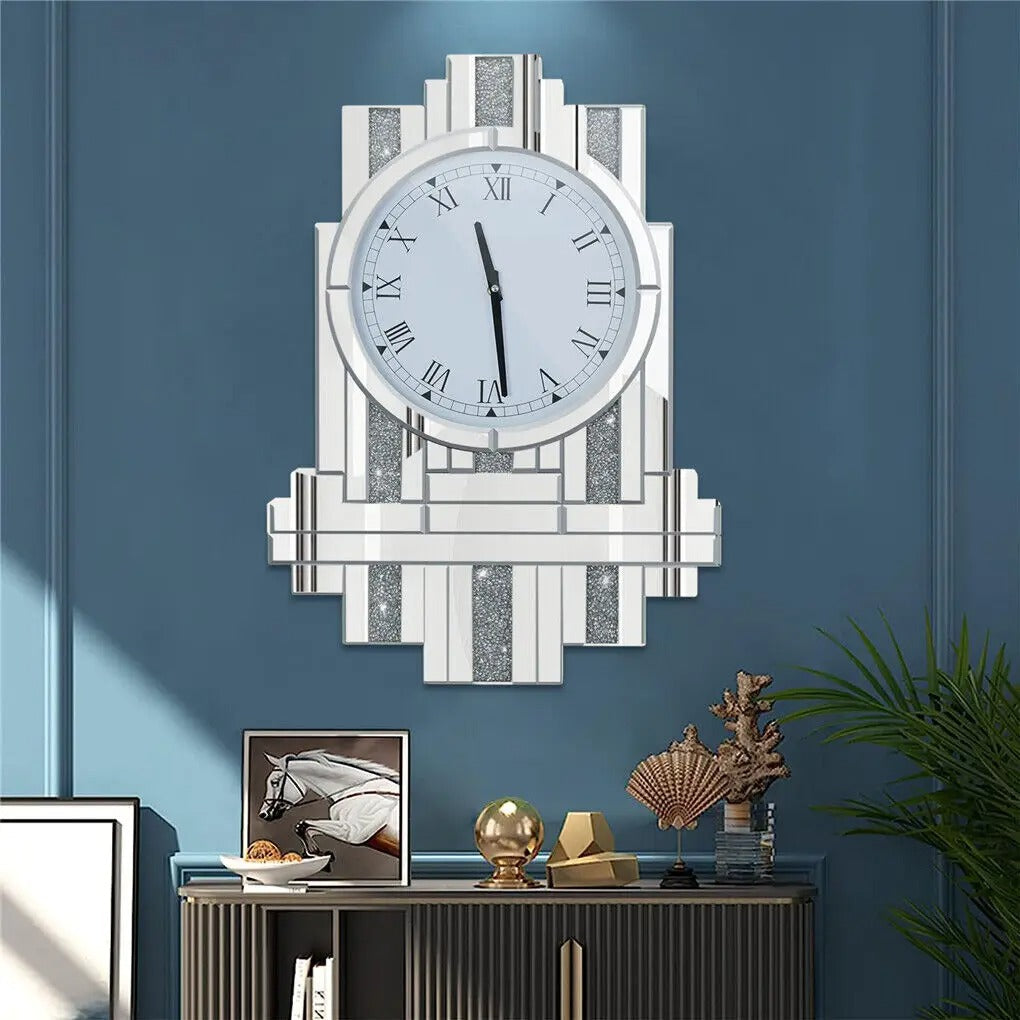
A wall painted in flat emulsion absorbs a significant portion of light. A gloss-painted wall reflects more. A mirrored surface reflects almost all of it. Objects on the wall participate in this process in proportion to their size and reflective quality.
A large decorative wall clock with a mirrored face and a crystal or metallic frame can reflect a meaningful amount of light back into a room. In a space where natural light is low - a north-facing sitting room, a narrow hallway, a dining room with small windows - this contribution is not trivial. It can make the difference between a room that feels gloomy in the evenings and one that feels adequately bright from relatively modest lighting.
The Impact of Clock Face Material
The face of a wall clock is its largest surface, and it is where the light interaction is most significant.
Plain printed faces - whether paper, card, or fabric-backed - absorb most of the light that falls on them. They are legible and often beautiful, but they do not contribute to the room's brightness. This is appropriate in rooms where the lighting is already strong and the goal is simply to tell the time attractively.
Metallic faces in silver, gold, or bronze reflect light at a lower intensity than mirrored glass, producing a softer, warmer glow rather than a sharp reflection. In rooms with warm artificial lighting - incandescent bulbs or warm white LEDs - a gold or bronze-toned metallic face picks up that warmth and adds a subtle luminosity to the wall.
Mirrored glass faces have the strongest light-reflective quality. They act in the same way as a small mirror, bouncing light directionally back into the room. The effect is most pronounced when the clock is positioned to receive direct light from a window or a lamp. In darker rooms or during the long autumn and winter evenings that define much of the British year, this can add genuine brightness to a wall that would otherwise be flat.
Crystal and diamond-effect detailing on a clock face or frame creates a scattered, multi-directional light effect rather than a single directional reflection. Crystal facets pick up light from multiple angles simultaneously, producing small points of brightness that make the clock - and the surrounding wall - feel animated. This effect is particularly noticeable in candlelit or low-lamp settings, where the crystal catches the warmer, more directional light and distributes it in a way that reads as genuinely atmospheric.
Our round crystal crushed diamond wall clock with a silver mirrored glass face is a good example of how these two elements work together. The mirrored face reflects broader ambient light while the crystal detailing adds the scattered, multi-directional quality that makes the clock feel alive in different lighting conditions throughout the day.
How Frame Finish Contributes to Mood
The frame of a wall clock is not just structural - it is the element that determines how the clock connects visually to the rest of the room, and it contributes to the overall warmth or coolness of the space.
Silver and chrome frames read as cool and contemporary. They suit rooms with cooler colour palettes - grey walls, blue-toned textiles, chrome fixtures - and they reflect light in a way that maintains the room's crispness rather than adding warmth.
Gold and brass frames warm a room's atmosphere. They absorb and re-emit light at the warmer end of the spectrum, and they connect naturally to rooms with earthy or warm-toned palettes. In a sitting room with amber or terracotta accents, a gold-framed clock reinforces that warmth in a way a silver frame would undercut.
Dark metal and black frames absorb rather than reflect, which makes them suitable for rooms that are already well lit and where the goal is to add contrast and definition rather than additional brightness. They are a good choice in rooms that receive strong natural light, where a reflective clock might create glare.
Crystal and mixed-material frames are more versatile because the crystal itself interacts with light independently of the frame's base colour. A silver frame with crystal detailing delivers both the cool reflective quality of the silver and the scattered warmth of the crystal - a combination that suits a wide range of British living room conditions.
Our large 3D diamond crystal wall clock with Roman numerals demonstrates this mixed-material quality well. The dimensional crystal elements catch light from different angles throughout the day as the light source shifts, which means the clock's visual character is not static - it changes subtly with the room's lighting conditions.
Placement: Making the Most of Light Interaction
Understanding how a clock interacts with light is only useful if that understanding informs where the clock is placed. The position of a wall clock relative to the room's light sources determines how much of its reflective potential is actually realised.
Opposite a Window
Positioning a mirrored or reflective wall clock on the wall that faces a window is one of the most effective ways to amplify natural light in a room. The clock reflects the light coming through the window back across the space, effectively doubling the light source's reach. This is a technique more commonly associated with mirrors, but a large decorative clock with a mirrored face can achieve a similar result on a smaller scale.
Adjacent to a Lamp
Placing a reflective clock near a floor lamp or a table lamp - close enough that the lamp's light falls on the clock face - creates a localised brightening effect on that section of the wall. In a sitting room corner with a single lamp, this can make the corner feel considerably warmer and more inviting than it would with a plain-faced clock or no clock at all.
Above a Fireplace
The relationship between a wall clock positioned above a fireplace and the light from the fire below is one that British homeowners have understood intuitively for a long time. A mirrored or crystal clock above an active fireplace catches and distributes the warm, flickering light of the fire in a way that significantly enhances the atmospheric quality of the room. This is part of why ornate, decorative clocks have traditionally occupied the mantelpiece position in British homes.
For a more detailed look at how clock placement decisions interact with room layout and lighting in UK homes, our piece on where to position a wall clock for maximum visual impact covers the practical considerations in depth.
The Role of Silence in Atmosphere
Ambience is not only visual. The auditory quality of a room - its background sound - contributes significantly to how the space feels. A ticking clock is one of the most immediately recognisable domestic sounds, and for some people it is deeply comforting. For others, particularly in rooms used for concentration, conversation, or relaxation, an audible tick can be distracting.
Most of the decorative wall clocks in the Metro Elegance range use silent quartz movements, which means the light-reflecting and atmospheric qualities of the clock are not accompanied by an audible tick. This is a small but meaningful detail in a room where ambience is a priority - it allows the clock to contribute visually without introducing an unwanted auditory element.
In a bedroom or home office, where silence is often valued, this distinction matters considerably. In a sitting room used for evening relaxation, a clock that adds warmth and reflected light without sound suits the atmosphere better than one that introduces a rhythmic tick into an otherwise quiet space.
Coordinating Clocks with Other Light-Reflective Decor
A wall clock does not exist in isolation. In a well-styled room, it sits alongside other decorative objects - mirrors, lighting fixtures, metallic accessories - that also interact with light. Understanding how these elements work together allows for a more intentional approach to the room's overall ambience.
A mirrored wall clock paired with a nearby wall mirror creates a mutually reinforcing light effect. The two pieces reflect light between them as well as back into the room, which can make a significant difference to a dark corner or a low-ceilinged space. Our wall mirror and wall decor collection includes mirrored and metallic frame styles that share material tones with many of our clock designs, making it straightforward to coordinate pieces across the same wall.

A crystal wall clock paired with a crystal chandelier in the same room creates a material consistency that elevates the overall quality of the space. Both pieces interact with light through the same mechanism - crystal facets distributing and scattering light in multiple directions - and the result is a room that feels considered and luminous rather than assembled from unrelated parts.
Our irregular mirrored wall clock with bevelled diamond mirror and Roman numerals is designed with exactly this kind of room in mind. The bevelled diamond mirror detailing connects naturally to crystal chandelier aesthetics, and the irregular silhouette gives it a distinctly decorative quality that goes well beyond functional timekeeping.
For those thinking about how chandeliers and wall decor can be coordinated to create a cohesive lighting atmosphere in a UK home, our guide on how chandeliers shape the atmosphere of UK living spaces covers the broader picture of layered lighting and its effect on room mood.
Matching the Clock to the Room's Intended Mood
Different rooms call for different atmospheric qualities, and the clock you choose should reflect this.
A dining room used for entertaining benefits from a clock that contributes to a warm, sociable atmosphere. A crystal or mirrored clock that catches candlelight and distributes it across the room suits this setting well. Our decorative wall clock collection includes several options with crystal and mirrored detailing specifically suited to rooms where evening ambience is a priority.
A home office or study benefits from a clock that is legible and relatively unobtrusive. A clean metallic face with a simple frame provides accurate timekeeping without creating reflective distraction in a space where focus is the goal.
A hallway benefits from a clock that amplifies the limited natural light typical of that space. A mirrored face and a reflective frame make a meaningful difference to how a narrow, low-light hallway feels - both practically and aesthetically.
For those who want a broader framework for choosing the right clock style to suit a specific room type and decor direction, our overview of what to consider when choosing a wall clock for a UK living room offers a practical starting point.
Have Questions About Which Clock Suits Your Space?
If you would like guidance on which wall clock finish or style would work best with the lighting conditions in your specific room, we are happy to help. Get in touch with the Metro Elegance team through our contact page and we can help you find the right piece for your home.
Frequently Asked Questions
Can a wall clock actually make a room feel brighter?
A wall clock with a mirrored or crystal face can reflect light back into a room, contributing to its overall brightness. The effect is most noticeable in darker rooms or during low-light conditions. While a clock alone will not transform a poorly lit room, a large mirrored-face clock positioned to catch window light or lamp light can make a measurable difference to how bright a section of wall feels.
What type of wall clock is best for a dark room or north-facing room?
A clock with a mirrored glass face or crystal detailing is well suited to darker rooms because it reflects available light rather than absorbing it. Positioning the clock on the wall opposite or adjacent to the primary light source - whether a window or a lamp - maximises this effect.
Do silent wall clocks affect the atmosphere of a room differently from ticking clocks?
The auditory element of a ticking clock contributes to a room's atmosphere for some people and detracts from it for others. In rooms where silence or low background noise is valued - bedrooms, home offices, relaxation spaces - a silent quartz movement allows the clock to contribute visually without adding sound. The choice between silent and ticking is largely personal, but it is worth considering for rooms where ambience is a priority.
How does clock frame finish affect a room's mood?
Frame finish contributes to whether a room feels warm or cool. Gold and brass frames add warmth and suit rooms with earthy or amber-toned palettes. Silver and chrome frames read as cool and contemporary. Dark metal frames add contrast and definition without reflective brightness. Crystal and mixed-material frames are versatile and interact with light in a way that suits a wide range of room types.
Where should I place a mirrored wall clock to maximise light reflection?
Position a mirrored clock on the wall that faces the room's primary light source - ideally opposite a window for natural light, or near a lamp for evening use. Above a fireplace is also an effective position, as the clock will catch and distribute the warm, directional light from the fire below.
Does a large decorative clock affect ambience more than a small one?
Generally yes. A larger clock face has more surface area to reflect or interact with light, and its greater visual presence means it contributes more significantly to the room's overall character. In a large room, a small clock may contribute too little to affect the ambience meaningfully.
Can I use a wall clock to complement a chandelier in the same room?
Yes. A crystal or mirrored wall clock pairs naturally with a crystal chandelier because both pieces interact with light through similar mechanisms - faceted surfaces distributing light in multiple directions. Using both in the same room creates material consistency and a layered lighting effect that suits dining rooms, sitting rooms, and formal living spaces particularly well.