
When houseplants struggle indoors, most people's first instinct is to look at watering habits or light levels. These are legitimate places to start - overwatering and inadequate light are genuinely common causes of plant decline. But there is a third factor that affects plant health just as directly and receives considerably less attention: airflow.
Plants that sit in still, stagnant air conditions are more vulnerable to a specific set of problems - fungal diseases, pest infestations, soil surface mould, and the build-up of humidity around leaves - than those in positions with reasonable air movement. In UK homes, where windows are frequently closed for six or more months of the year and central heating runs for long stretches, still indoor air is a persistent condition that affects a large proportion of houseplants.
A plant stand does not in itself solve all airflow problems, but it changes the conditions around a plant in ways that are directly relevant to air circulation. Understanding how and why helps make better decisions about which stand to use, how to position it, and how to arrange plants across it. At Metro Elegance, we think the practical case for plant stands goes well beyond aesthetics, and airflow is one of the clearest practical arguments for elevation.

Why Airflow Matters for Plant Health
To understand why airflow benefits plants, it helps to think briefly about what plants are doing in the air around them and why the quality of that air matters.
Transpiration is the process by which plants release water vapour through the tiny pores in their leaves, called stomata. This process is part of how plants regulate their temperature and how they draw water and nutrients up through their root system. When the air immediately around a plant is already saturated with humidity - as it tends to be when plants are crowded together in still conditions - transpiration slows or becomes less efficient. This affects the plant's ability to take up water and nutrients at the rate it needs.
Gas exchange through the stomata also involves carbon dioxide absorption and oxygen release. In very still air, the thin layer of depleted air immediately around the leaf surface - where CO2 has been absorbed and where oxygen has been released - does not refresh as effectively as in moving air. This is a subtle effect in most home settings, but it is a real one, particularly for plants in enclosed corners with minimal air movement.
Fungal disease is probably the most practically significant consequence of poor airflow for UK houseplants. Fungal pathogens - including the grey mould Botrytis cinerea and various leaf spot and powdery mildew species - thrive in warm, humid, still conditions. When plants sit closely together in positions where air does not move freely, the micro-environment around the leaves stays damp for longer after watering or misting, which extends the period during which fungal spores can establish on leaf surfaces.
Soil surface conditions are also affected by airflow. A plant pot in still air maintains a damp soil surface for longer after watering than one in a position with reasonable air movement. Persistently damp soil surfaces encourage the growth of algae, fungus gnats (which lay their eggs in the top layer of damp soil), and surface mould. These problems are consistently more common in plants positioned at floor level in corners or against walls where air movement is minimal.
Root zone conditions benefit from the gap that an elevated stand creates between the pot base and the surface beneath. When a pot sits directly on a floor or shelf, the drainage holes are partially or fully blocked by contact with the surface. Air cannot circulate around the base of the pot, which means the drainage holes do not dry out between waterings. This contributes to the consistently damp root zone conditions that precede root rot in susceptible plants.
How Elevation Changes Air Conditions Around Plants
The act of placing a plant on a stand rather than on the floor or a solid surface changes the air conditions around it in several specific ways.
Lifting out of floor-level stagnant air. Air movement in a room is not uniform. In most homes, the air closest to the floor is the least disturbed - it sits below the level where human movement, convection from heating, and any window ventilation creates circulation. A plant on the floor in the corner of a room is in the part of the room with the least air movement. The same plant elevated even thirty to fifty centimetres on a stand sits in meaningfully better-circulated air, even in a room where overall ventilation is limited.
Creating clearance beneath the pot. A stand with a slatted, open, or raised shelf surface allows air to circulate beneath the pot as well as around its sides and above its soil surface. This is relevant both for the drainage hole conditions described above and for the general air environment immediately around the root zone. Open-framed stands - those with metal bars or bamboo slats as the shelf surface rather than solid boards - provide better airflow beneath the pot than those with solid wooden shelves.
Reducing surface contact. When a pot sits on a solid surface, the area of contact between the pot base and that surface retains moisture from drainage and creates a small zone of still, damp conditions. A stand that elevates the pot on an open frame or on raised feet reduces this contact area, allowing both the pot base and the surface beneath to dry more effectively between waterings.
Our 5-tier bamboo modern plant stand designed for patio and indoor use uses a bamboo slatted construction that allows air to move through the shelf surfaces as well as around the sides of the stand. For plants in UK homes where fungal issues and soil surface problems are persistent concerns, this open construction is more beneficial than a solid-shelf alternative at the same height.
Spacing Plants Correctly on a Multi-Tier Stand
Elevation alone is not sufficient if plants are placed too closely together on the stand. Crowding plants - even when they are elevated - recreates the still, humid micro-environment that causes the problems elevation is intended to address.
The principle is that each plant needs adequate space around it for air to move freely between its leaves and those of its neighbours. A useful practical check is whether you can pass your hand between the foliage of adjacent plants without significant contact. If the leaves of two plants overlap or touch, the area between them is likely to retain humidity and have limited air movement - conditions that increase fungal disease risk for both plants.
On a tiered stand, the spacing between tiers matters as well as the spacing between pots on each tier. Tiers placed very close together leave little vertical space for air to circulate between the foliage of the lower tier and the underside of the shelf above. Most well-designed tiered stands have adequate vertical spacing between shelves for this purpose, but it is worth being mindful when placing plants with wide or spreading foliage on the lower tiers of a densely planted arrangement.
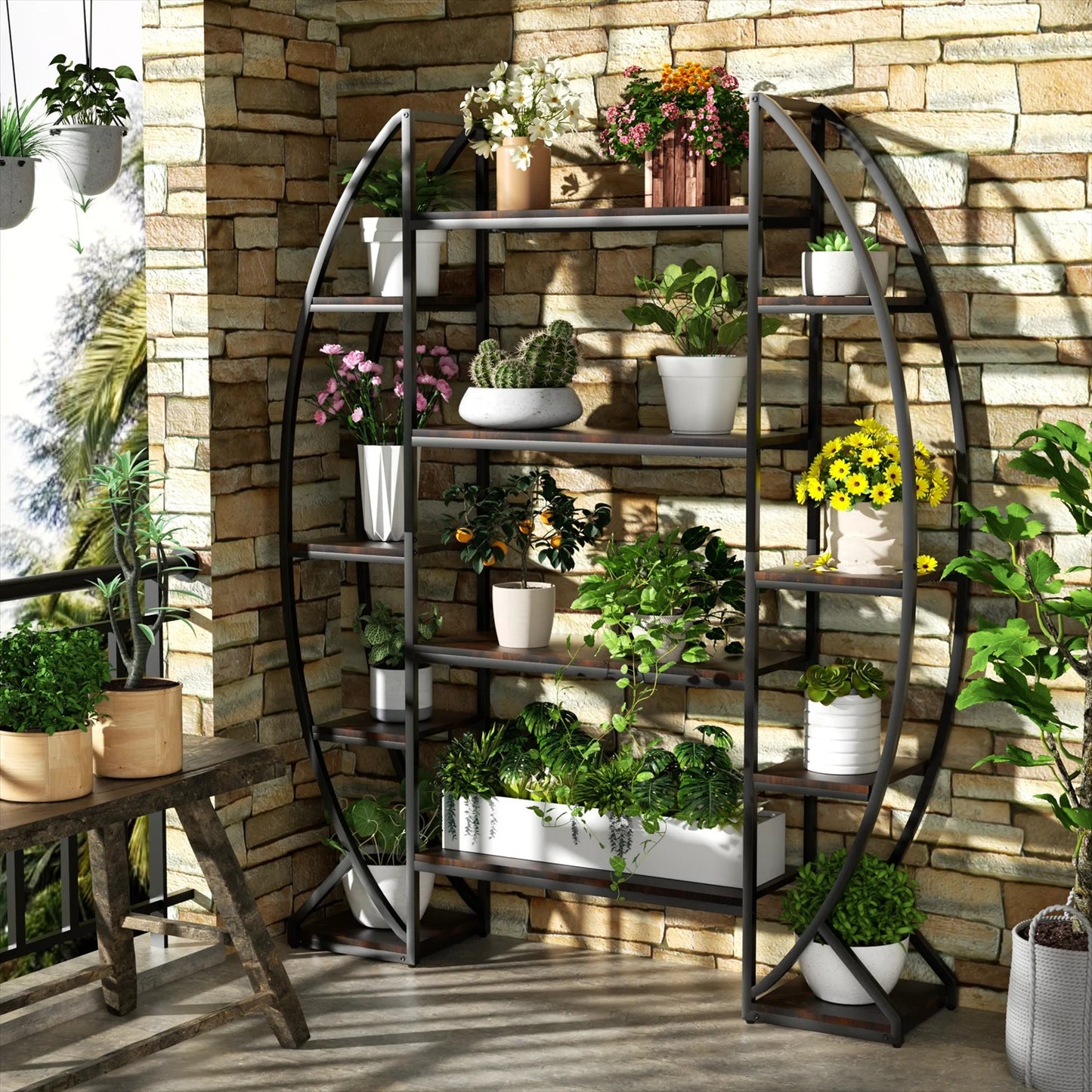
Our 6-tier large triangular wood plant stand for corner display has a triangular profile that naturally encourages plants to be arranged with some spacing between them, as the shelves narrow toward the upper tiers. This built-in spacing geometry is beneficial for airflow across the display compared with arrangements where all tiers are the same width and the temptation is to fill every available space on each shelf.
Stand Type and Construction: What Affects Airflow Most
The construction of the stand itself affects how well air moves around the plants it holds. A few design characteristics are particularly relevant.
Open frame versus solid shelf. An open-framed metal stand or one with slatted bamboo or timber shelves allows air to move through the stand structure itself - between the frame members, through the shelf surface, and around the pot in all directions. A stand with solid wooden shelves limits air movement from below the pot and between the frame elements. For plants where airflow is a specific health concern, an open-framed construction is preferable.
Stand height and room position. The further from the floor a plant is positioned, the better-circulated the air around it tends to be in most rooms. A plant on the upper tier of a tall stand is in the part of the room where convection from heating, movement, and any window ventilation are most active. This is a meaningful difference from a plant on the lower tier of the same stand, which is still elevated from the floor but sits in calmer air.
Corner versus wall versus room position. A stand in the corner of a room, while visually effective and space-efficient, places plants in the least well-ventilated position in most rooms - the point furthest from windows and where two walls create a relatively still air pocket. A stand positioned along a wall but not in a corner, or positioned in the room rather than against a wall, generally provides better airflow conditions. For plants that are susceptible to fungal issues, this positioning consideration is worth weighing against the visual and space benefits of corner placement.
Practical Airflow Tips for UK Homes in Winter
The conditions in UK homes during the heating season - from roughly October through March - create the most challenging airflow environment for houseplants. Windows are closed for most of this period, central heating dries the air unevenly and creates stagnant warm pockets near radiators, and the reduced outdoor temperatures mean that any window ventilation that does occur comes with a cold draught risk for sensitive plants.
A few measures help maintain adequate airflow around plant stand displays during these months:
Brief ventilation periods - opening a window for fifteen to twenty minutes once or twice a day - introduce fresh air movement into the room and break up the stagnant conditions that accumulate overnight and during longer periods with no ventilation. Positioning the plant stand away from the direct draught path during ventilation protects sensitive plants while still benefiting from the general air movement created.
A small fan on a low setting placed to move air gently across a large plant display can maintain air movement in rooms where natural ventilation is rarely possible during winter. The fan should create movement rather than a direct strong draught - the goal is air circulation, not wind exposure.
Increasing spacing between plants during winter reduces the micro-humidity that accumulates between closely placed pots in still indoor conditions. This is particularly useful for plants on tiered stands during the period when fungal disease risk is highest.
For a comprehensive view of how stand placement - including how stand position within a room affects light access as well as airflow - affects plant health across all seasons, our guide on where to place indoor plant stands for the best light and growing conditions covers the practical placement decisions that affect both light and air quality together.
Metro Elegance's indoor plant stand collection includes a range of open-framed and tiered options suited to the airflow considerations described in this guide. Our metal plant stand range in particular features open-frame constructions in metal that allow good air movement around plants at multiple heights - a practical choice for anyone whose plant collection has been struggling with the fungal or soil surface issues associated with poor airflow.
Our bamboo 4-tier plant stand holder is another well-suited option - the slatted bamboo shelf surfaces and open frame construction at each tier level create better air movement around the pots than a solid-shelf equivalent while keeping the natural material aesthetic that suits most UK interior styles.
For the broader picture of how plant stands benefit plant health across multiple dimensions - light, drainage, airflow, and protection from physical disturbance - our post on the practical benefits of elevating your plants on a stand draws these threads together in one place.
Good airflow is one of those plant care factors that is easy to overlook because its effects accumulate gradually rather than showing up immediately. A plant in poor air conditions does not visibly decline overnight. But over weeks and months, the difference between a plant in a well-ventilated elevated position and one on the floor in a still corner becomes increasingly apparent in the plant's health, its resistance to disease, and its overall growth rate. A plant stand is one of the simplest and most practical ways to improve that condition.
Want Help Choosing the Right Stand for Your Plants?
If you would like specific advice on which Metro Elegance stand suits your plant collection and room conditions, our team is happy to help. Get in touch with us here and we will give you straightforward, practical guidance.
Frequently Asked Questions
Do plant stands really improve airflow around plants?
Yes, in a specific and meaningful way. Elevating a plant on a stand moves it from floor-level stagnant air into the better-circulated air of the room's main space. The gap created between the pot base and the surface beneath also allows air to reach the drainage holes, which benefits root zone conditions. Open-framed stands allow air to move through the shelf surface as well as around the pot sides, which improves air circulation further.
Can poor airflow cause plant health problems?
Poor airflow around indoor plants contributes to several common health problems: fungal diseases including grey mould and powdery mildew thrive in still, humid conditions; fungus gnats are more prevalent when soil surfaces stay damp due to limited air movement; root conditions can deteriorate when drainage holes are blocked by contact with a solid surface and the root zone stays consistently wet. Improving airflow does not address all plant health issues but is a genuine contributing factor in the problems listed.
How much space should I leave between plants on a stand?
A practical check is whether you can pass your hand between the foliage of adjacent plants without significant leaf contact. Plants whose foliage overlaps or touches sit in a micro-environment of still, humid air that increases fungal disease risk for both. On tiered stands, also ensure that the vertical space between tiers is sufficient to avoid the foliage of lower-tier plants being enclosed by the shelf above.
Are open-frame stands better for plant health than solid-shelf stands?
Open-framed stands - those with metal bars, bamboo slats, or similar open constructions as the shelf surface - allow air to move through the shelf itself and around the base of the pot, which is better for airflow than a solid wooden shelf where air movement from below is blocked. For plants susceptible to fungal issues or root problems, an open-framed construction is preferable to a solid-shelf alternative at the same height.
Why do plants in UK homes particularly need good airflow in winter?
During the UK heating season, windows are frequently closed for long periods and central heating creates warm, still indoor air conditions. This combination - warm temperature, limited ventilation, and no air movement from windows - creates the conditions that favour fungal disease and surface mould on houseplants. Elevating plants on stands and ensuring adequate spacing between them partially compensates for these conditions by improving the air environment immediately around the plants.
Does stand position in the room affect airflow around plants?
Yes. A stand positioned in a corner of the room sits in the least well-ventilated part of most interiors - the point furthest from windows and where two walls create a relatively still air pocket. A stand along a wall but not in a corner, or positioned away from walls in the main room space, provides better air movement around plants. For plants susceptible to fungal issues, this is worth considering alongside the visual and space benefits of corner placement.
How do I improve airflow for plants on a stand during winter?
Brief periods of window ventilation - fifteen to twenty minutes once or twice daily - introduce air movement into the room without prolonged cold exposure for the plants. A small fan on a low setting can maintain gentle air circulation across a plant display in rooms where window ventilation is rarely possible. Increasing the spacing between plants on the stand during winter reduces the micro-humidity that accumulates between closely placed pots in still indoor conditions.